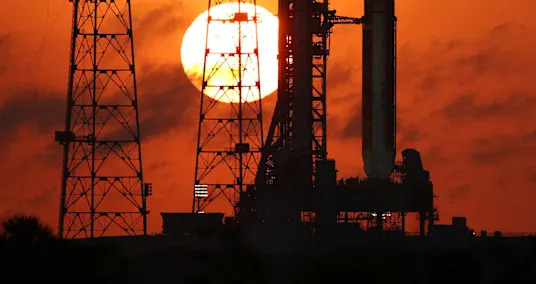
A launch pad at Russia’s main space complex was damaged during Thursday’s launch of a mission carrying two Russians and an American to the International Space Station, Moscow’s space agency announced.
The Soyuz MS-28 spacecraft successfully docked with the space station and the three crew members had boarded, Roscosmos said.
But a post-launch inspection at the Baikonur Cosmodrome in Kazakhstan revealed “damage to several elements of the launch pad,” according to a statement from Roscosmos, which still uses the space facility in its former Soviet neighbor.
“An assessment of the condition of the launch complex is currently underway,” it said, adding that all parts needed to repair the pad are available.
“The damage will be repaired in the near future.”
The launch pad contains support systems for the rocket and a structure that allows cosmonauts to access their capsule as it sits atop a Soyuz rocket.
Launch pads must be capable of withstanding extreme heat, air pressure and vibrations as a rocket takes flight.
Russian analysts said repairs to the launch pad could take a week or longer. And any lengthy delay could leave Russia unable to launch missions to the space station, they said.
“In the worst case this could seriously affect the rotation of crewed missions and cargo flights to the ISS,” analyst and blogger Georgy Trishkin wrote on Telegram.
Typically, ISS crew are launched roughly every six months from Baikonur.
“This is the only launch pad Roscosmos uses for the ISS program, and in the future it was supposed to be used for launches to the Russian Orbital Station,” commentator Vitaliy Egorov wrote on Telegram.
“In effect from this day Russia has lost the ability to launch humans into space, something that has not happened since 1961. Now it will be necessary to quickly repair this launch table or modernize another one,” Egorov wrote.
Besides Russia’s Soyuz craft, NASA uses SpaceX’s Dragon spacecraft to take crew to the ISS.
The three men aboard the mission that lifted off Thursday join seven other crew already orbiting on the ISS.
Three are scheduled to return to Earth by December 8, according to NASA.
For more CNN news and newsletters create an account at CNN.com
latest_posts
- 1
 Italian police hold suspected boss of Naples Mafia's Mazzarella Clan
 - 2Merck sees over $5 billion opportunity in Cidara's experimental flu drug
- 3Raw oysters linked to ongoing salmonella outbreak infecting 64 across 22 states: CDC
- 4Kissing is an ‘evolutionary conundrum.’ Scientists just mapped its unexpected origins
- 5The most effective method to Comprehend the Variables Affecting Medical attendant Pay rates



- Doulas play essential roles in reproductive health care – and more states are beginning to recognize it
- Share your number one city visit transport that leaves a mark on the world wake up!
- German unemployment rate falls to 6.4%, but 3 million still jobless
- NASA's make-or-break moon shot
- Remain Fit: Powerful Wellness and Work-out Schedules for a Better You
- Quantum Computing’s Next Major Breakthroughs Could Come From Australia
- Brazil's ex-president Bolsonaro operated on for hernia
- At least 490 protesters killed in Iran, activists say
- I visited the largest collection of public telescopes in the US in Oregon's high desert, and the dark skies blew me away